
Reading path: Sharks, tracking and fossils →
Questions to keep separate
| Question or feature | Explanation | What it does not establish |
|---|---|---|
| Depth and ascent duration | The Seal Island study recorded launches from up to 20 m and final ascents of about 7–16 seconds. [1] | These are observations from a particular South African seal-hunting study. |
| Peak speed | Modeled peak speed in those measurements reached about 6.5 m/s. [1] | It is not a verified speed for an unmeasured California clip. |
| Prey and life stage | CDFW describes juvenile diets centered on fishes and rays and broader adult diets that include marine mammals. [2] | Diet patterns do not identify the motive for an individual breach. |
| A sighting versus contact | CDFW excludes sightings without contact from its human-contact incident definition. [2] | A jump alone does not establish contact or an attack. |
What a breach physically involves
A breach is a whole-body or near-whole-body launch from the water. It requires a rapid upward swim, so the visible jump is the end of an underwater sequence rather than a complete account of what the animal was doing. A surface clip may omit the approach, prey, depth and activity nearby. [1]
To measure that hidden sequence, researchers studying white sharks at South Africa’s Seal Island combined animal-borne video with accelerometers and depth sensors. Their study examined attacks on Cape fur seals during breaches. The instruments let researchers connect a surface exit to underwater movement rather than inferring the whole event from a distant view. [1]
The measured launch—and its boundaries
In the Seal Island observations, launches began from depths as great as 20 meters. Final ascents lasted roughly 7 to 16 seconds, and modeled peak speed reached about 6.5 meters per second. Tail-beat frequency was substantially higher during breaches than during non-predatory ascents, consistent with the powerful acceleration needed for a hunting launch. [1]
These are measurements from a specific seal-hunting setting, not universal constants for every white shark or every jump. They demonstrate a plausible mechanism and a documented behavior, but do not prove that a particular California breach involved a seal, prey, or even a hunting attempt.
Separate identification from explanation
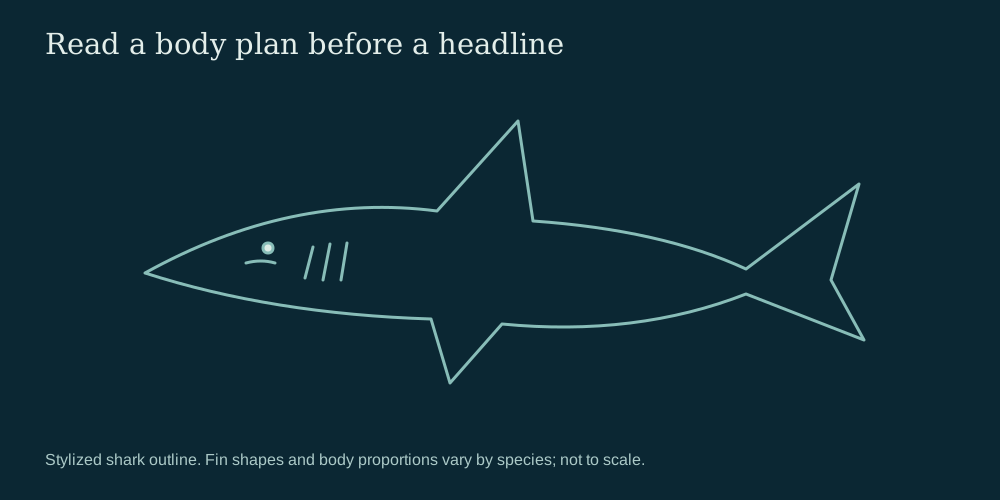
White sharks have a robust, torpedo-shaped body, a conical snout and strong dark-to-light contrast. Those traits can support an identification, but CDFW notes that makos and salmon sharks can resemble them enough that several features should be considered together. A caption or a brief silhouette is not a substitute for clear original footage. [2]
The animal’s life stage also matters when considering prey. CDFW describes juvenile white sharks as favoring fishes and rays, while adult diets include a broader range that includes marine mammals. This makes a seal-hunt explanation more plausible in some contexts than others, but diet tendency is not proof of the cause of one jump. [2]
A California clip evidence exercise
For a hypothetical California breach video, first preserve the original capture time and location, then inspect continuous frames before and after the jump. Look separately for an identifiable shark, visible prey, and evidence of a chase; seek an independent angle or confirmation from a relevant park official. If the original file and location are unavailable, the event’s date and setting remain unverified.
Monterey Bay research documented a juvenile-dominated white-shark aggregation and expanded thermal habitat after the 2014–2016 marine heatwave, using observations, photogrammetry, biologging and environmental data. That regional study provides ecological context, not authentication of a particular clip or evidence that a specific Marina encounter occurred. [3]
Finally, distinguish a jump from a human-contact incident. CDFW’s incident definition excludes sightings where no contact occurred. A breach by itself therefore does not establish a bite attempt or contact with a person or their equipment. [2]
Sources & further reading
Have a correction or a source to suggest? Send a note →