
Reading path: Sharks, tracking and fossils →
Questions to keep separate
| Question or feature | Explanation | What it does not establish |
|---|---|---|
| Observation record | Note time, shoreline landmark, direction, distance estimate and preserve continuous original video. [2] | A report from shore does not by itself confirm species or an advisory. |
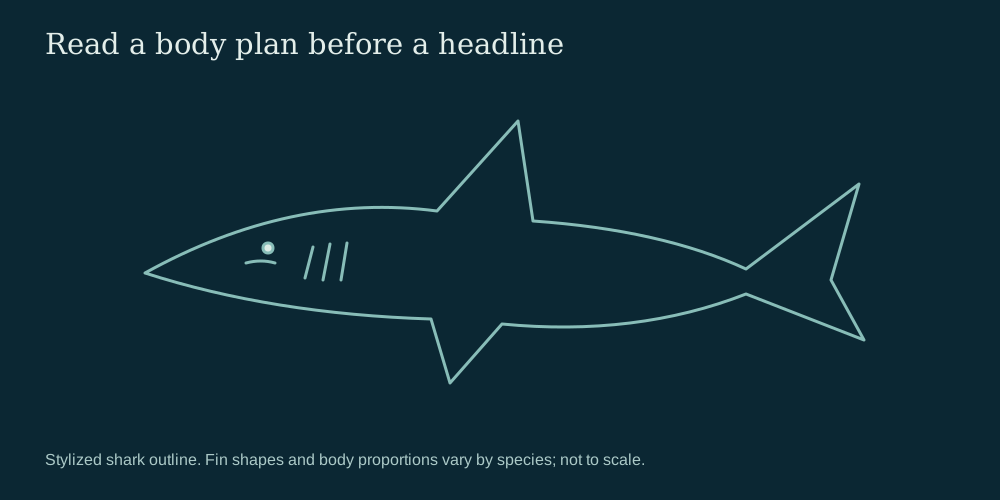
| White-shark traits | Robust torpedo-shaped body, conical snout and strong dark/light contrast support comparison. [2] | Makos and salmon sharks can resemble white sharks. |
| Monterey Bay juvenile study | Research documented increased juvenile presence during 2014–2019 using several observation and tagging methods. [3] | The Seacliff aggregation is not a Marina count or present-day estimate. |
| Rip-current response | Rip flow moves seaward; alert a lifeguard or call 911 and throw flotation for rescue. [4] | Clues may not all be visible; local surf conditions must be checked. |
What the place information establishes
Marina State Beach lies at the foot of Reservation Road in Marina, on Monterey Bay. The California State Parks page describes water recreation there as extremely hazardous because of strong rip currents. That is a site-specific baseline hazard; a shark sighting or the absence of a shark notice does not change it. [1]
The same beach page establishes location and park contact information, but it does not confirm a dated shark sighting. A report hosted or linked by a park is not automatically first-party field confirmation. Before describing a particular event as verified, a report would need evidence tied to its time and place. [1]
Three steps in a shark report
Keep observation, identification and official response distinct. “A large dorsal fin was seen” records an observation. “A white shark was identified” adds an identification that should rest on visible traits or qualified review. “An official advisory was issued” is a separate claim requiring confirmation from the relevant authority.
A hypothetical observer can make a useful report from a safe shore position by noting the time, exact shoreline landmark, direction of travel, approximate distance and whether the video is continuous. Submit the record to park staff or a lifeguard; do not enter the water to obtain a closer image. CDFW describes white sharks as having a robust torpedo-shaped body, conical snout and strong dark/light contrast, while warning that makos and salmon sharks can resemble them. [2]
Regional evidence is not a beach count
A primary Monterey Bay study combined observer logs, photogrammetry, tagging and environmental data. It documented increased juvenile white-shark presence during 2014–2019, and its illustrated Seacliff aggregation is a specific location distinct from Marina State Beach. The evidence supports regional presence and a juvenile pattern; it does not establish how many sharks are near Marina today. [3]
The study’s illustrated sharks were overwhelmingly juveniles under 2.5 meters, but that figure describes the study observations and should not be generalized into a current Marina size estimate. Young white sharks commonly feed on fishes, smaller sharks and rays, another reason not to assume that a nearby shark is pursuing a person. [3] [2]
Read the water independently
Rip-current safety remains relevant whether or not a shark is reported. The National Weather Service explains that a rip current flows seaward rather than pulling swimmers downward; its speed may exceed a swimmer’s. A gap in breaking waves can be one clue, but one, all or none of the visible clues may appear. [4]
For current conditions or access restrictions, check local lifeguard and park instructions directly. The beach’s documented strong-current warning is not a live surf report, and regional shark research is not a current advisory. If someone is in trouble, the Weather Service advises alerting a lifeguard or calling 911 and throwing flotation rather than entering the water for a rescue. [1] [4]
Sources & further reading
Have a correction or a source to suggest? Send a note →