
Reading path: Octopus anatomy and behavior →
Questions to keep separate
| Question or feature | Explanation | What it does not establish |
|---|---|---|
| Two-arm walk | The octopus moves backward with two arms rolling against the seabed while six curl around the body [1]. | Arms do not bend at rigid knees; the animal still has eight arms [2]. |
| Arm support | Muscle and nearly incompressible tissue support an arm without a bony skeleton [2]. | The mechanism explains flexible support, not the purpose of every walk [2]. |
| Observed speeds | Two observed coconut octopuses moved at about 2.5 and 5.5 inches per second [1]. | Two individuals do not establish a species-wide speed range [1]. |
| Shell transport | Shell halves were transported and later assembled into shelters [3]. | The shells provided no protection during transport; this differs from two-arm walking [3]. |
Two arms contact the bottom in turn
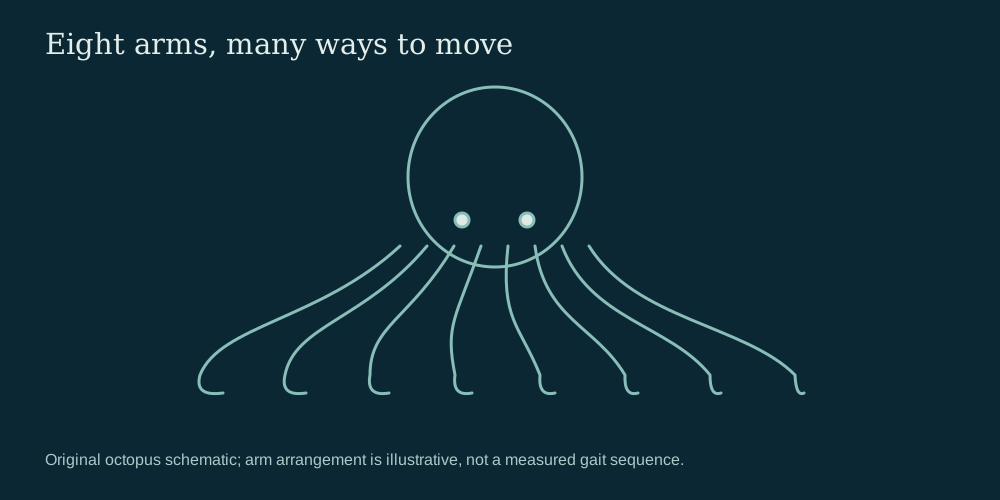
The coconut, or veined, octopus is Amphioctopus marginatus; the 2005 locomotion report used the name Octopus marginatus. Researchers documented it moving backward on two arms while curling the other six around its body [1]. The compact shape can look like a small animal walking on two legs, but the octopus still has eight arms. Calling them legs can conceal what is unusual about the movement: arms adapted for flexible contact are serving as supports and locomotor surfaces.
Watch the points of contact rather than mapping the motion onto human anatomy. The two arms roll against the seabed with alternating contact. They do not hinge at rigid knees. The backward movement can therefore look like stepping in a video, although the mechanics come from arm shape and controlled contact with the bottom [1] [2].
How an arm supports itself
An octopus arm is a muscular hydrostat. Muscle and nearly incompressible tissue provide support without a bony skeleton. Because there is no rigid internal framework, the arm can bend and change shape while maintaining the tissue volume that helps it resist compression [2].
That anatomy makes a rolling gait possible: an arm can press against the seabed, shift its contact, and take the next turn in the alternating sequence. A useful comparison is a two-arm walk versus ordinary arm crawling. In the documented walk, six arms are curled around the body and two provide the visible rolling contacts; in crawling, the body is supported and moved through a broader set of arm contacts. The compact outline may help preserve camouflage during travel, but that is a proposed advantage, not proof that every walk is an escape [1] [2].
What the measured speeds tell us
In the reported observations, two coconut octopuses moved at about 2.5 and 5.5 inches per second. Those are measurements for two individuals, not a universal speed range for the species [1]. The difference between the values is a reminder to retain the denominator: two observed animals cannot define all individuals, conditions, or purposes of movement.
The same 2005 work also documented two-arm walking in the algae octopus, Abdopus aculeatus [1]. That comparison shows the locomotor pattern is not exclusive to the coconut octopus. It does not establish that the two species use it for identical reasons. A short video showing two arms on the bottom is evidence of a movement pattern; without context, it may not reveal why the animal is moving.
Shell carrying is a different event
Coconut octopuses also transport coconut shell halves. A separate study documented shells being carried and later assembled into shelters [3]. The carrying phase imposed a cumbersome, stilt-like gait, and the shells offered no protection while being transported. The later protective use, after transport and assembly, is what made this behavior relevant to tool-use discussions [3].
This distinction matters when identifying a clip. A compact octopus rolling backward with no shells is showing the two-arm locomotor pattern. An animal bearing shell halves is transporting material, with the awkward gait associated with that load. Both can appear to walk along the bottom, but only the second sequence connects transport to later shelter use. A clip that ends before assembly cannot, on its own, show the later protective use [1] [3].
Keep the interpretation within the observation
The observed movement supports a specific explanation of mechanics, not a broad ranking of intelligence or proof of human-like planning. Likewise, camouflage preservation is a plausible functional interpretation, but it does not show that every two-arm walk is defensive [2]. Separate the sequence into what is visible—arm contacts, direction, body outline, and whether shells are present—and what is inferred about purpose.
That approach avoids two common errors: treating arms as anatomical legs and collapsing shell carrying into ordinary two-arm walking. The research documents both behaviors, but distinguishes them. It also does not make a brief online clip self-explanatory; establish whether the animal carries shells before describing the movement as transport [1] [3].
Sources & further reading
Have a correction or a source to suggest? Send a note →