
Reading path: Octopus anatomy and behavior →
Questions to keep separate
| Question or feature | Explanation | What it does not establish |
|---|---|---|
| Display mechanics | Posture, pattern, arm arrangement, and movement combine to alter the animal's outline [1]. | A resemblance to another animal does not mean the octopus transforms into it or prove predator perception [1]. |
| Flatfish-like movement | The arms draw together into a flattened, leaf-like shape near the bottom [1]. | A still image omits movement, which is part of the observed resemblance [1]. |
| Evidence base | The 2001 study observed nine adults over 16 days in Sulawesi and Bali [1]. | That sample and observation period do not establish every display's function or prevalence [1]. |
| Evolutionary comparison | Long arms and flatfish swimming were associated within a sand-dwelling clade; banding may be secondary [3]. | The comparison does not prove one purpose for all conspicuous patterns [3]. |
A display is a moving combination
The mimic octopus, Thaumoctopus mimicus, does not become another animal. It changes posture, pattern, and movement in combinations that can make its body resemble something else. In the original observations, all nine animals studied displayed multiple forms; the evidence therefore describes a repertoire, not a fixed one-to-one costume for each individual [1] [2].
Begin by looking at the whole sequence. A still frame may show bands or a flattened outline, but motion helps make the resemblance legible. The arms can trail, fold together, or move in opposing directions, changing both silhouette and apparent travel style. The original researchers were most confident in comparisons with a sole, a lionfish, and a banded sea snake—not every animal later listed in popular accounts [1].
From quiet foraging to a flatfish outline
During ordinary foraging, the octopus often appeared drab brown and close to the surrounding bottom. That is background matching: the animal's appearance reduces contrast with its setting. It differs from a display that makes an animal conspicuous by resembling a potentially dangerous model. The two effects can occur in the same animal, but they are not the same mechanism or claim [1] [3].
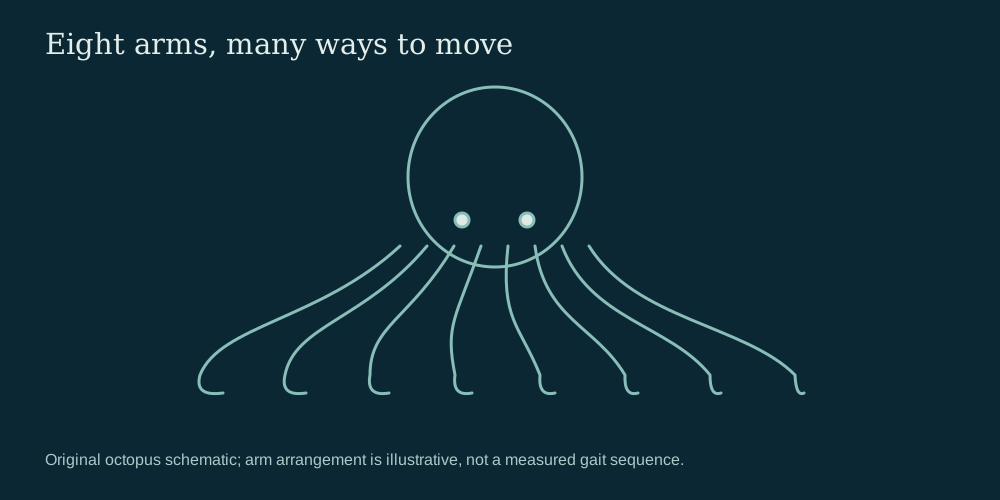
For flatfish-like swimming, the arms draw together into a flattened, leaf-like shape held near the seabed. This is more than a color change: the arm arrangement alters the outline, and the low, gliding movement supplies another part of the comparison. Imagine the same octopus probing a burrow in a drab posture, then bundling its arms and moving quickly across the bottom. The contrast lies in shape and movement as well as color [1].
Two other recognizable configurations
In another display, the animal spreads trailing arms in a way the observers compared with a lionfish's fins and spines. The comparison describes a visual configuration; it does not establish that the octopus has spines or that the display has one proven effect on every viewer [1].
In the sea-snake-like display, six arms may remain hidden while two banded arms move in opposite directions. Concealing most of the arms and animating the visible pair produce a different outline and motion from the flattened sole-like form. A useful evidence-reading exercise is to compare a brief still with a continuous clip: note which arms are visible, how they move, and whether the body remains close to the bottom. The clip can support a description of behavior; by itself, it cannot prove what a fish perceived [1].
What comparison studies can—and cannot—explain
A later comparative and phylogenetic study treated flatfish swimming, long arms, and high-contrast banding as features that may have different evolutionary histories. Long arms and flatfish-like swimming were associated within a sand-dwelling clade, while conspicuous coloration may have evolved as a secondary adaptation [3].
That distinction cautions against treating every feature as a single, fully explained disguise package. Human observers may see a convincing resemblance, but that does not establish how a fish predator classifies it. Nor do observations of context-associated displays prove that an octopus consciously selects the best disguise. Proposed functions remain hypotheses where the studies did not test them directly [3].
Describe the evidence at the right scale
When identifying a display, separate observation from interpretation. “The arms were drawn together and the animal moved close to the bottom” describes visible behavior. “It impersonated a sole to fool a particular predator” adds claims about model identity, audience, and function that require additional evidence. The original authors' confidence in sole, lionfish, and banded sea-snake comparisons is more defensible than an exact list of dozens of imitated species [1].
Also avoid assuming that every flatfish is toxic or that every high-contrast pattern has the same defensive purpose. The available observations establish flexible changes in appearance and behavior; they do not settle the predator's response or the function of every display. A careful account can explain the mechanics while leaving those questions open [1] [3].
Sources & further reading
Have a correction or a source to suggest? Send a note →