
Reading path: Shoreline wildlife encounters →
Questions to keep separate
| Question or feature | Explanation | What it does not establish |
|---|---|---|
| True-seal anatomy | No external ear flaps; hind flippers do not rotate beneath the body for walking. [1] | A distant or partial view may hide these traits. |
| Haul-outs | Used for rest, molting, warming, birth and nursing. [2] | Being ashore alone does not show that a seal is stranded. |
| Pupping season | Generally earlier in southern West Coast areas than northern ones. [3] | Births can occur outside typical regional windows. |
| Population scale | NOAA treats harbor seals as multiple stocks with differing trends. [1] | One stock’s trend does not describe all Pacific colonies. |
Read the whole silhouette
The harbor seal, Phoca vitulina, is a true seal; eastern North Pacific animals are commonly treated as the subspecies P. v. richardii. Unlike a sea lion, it has no external ear flap. Its short, dog-like snout and mottled coat can help distinguish it, but neither feature alone settles an identification when the animal is far away or partly submerged. A spotted head above the water is a useful first clue, not proof of species or age. [1]
Movement on shore provides another comparison. A sea lion can rotate its hind flippers forward beneath its body and use them to help walk. A harbor seal cannot; it moves by flexing and undulating its body, which may look awkward or caterpillar-like. That appearance is normal for its anatomy and is not, by itself, evidence of an injury. [1]
For a distant animal, compare several observable traits without approaching: look for an ear opening rather than a visible flap, note the short muzzle and mottled coloring, then consider how it moves if it hauls out. A blurry photograph may not show the ear clearly, and a seal that remains in the water offers no view of its land gait. Treat the identification as tentative when those details cannot be seen together. [1]
A haul-out is part of the habitat
Pacific harbor seals use coastal waters and shore sites from Baja California to the Bering Sea. They eat varied fishes, crustaceans and other marine prey, so describing them as dependent on one fish species oversimplifies their feeding ecology. Their prey choices can vary; the broad diet description does not establish what a particular seal has eaten. [1]
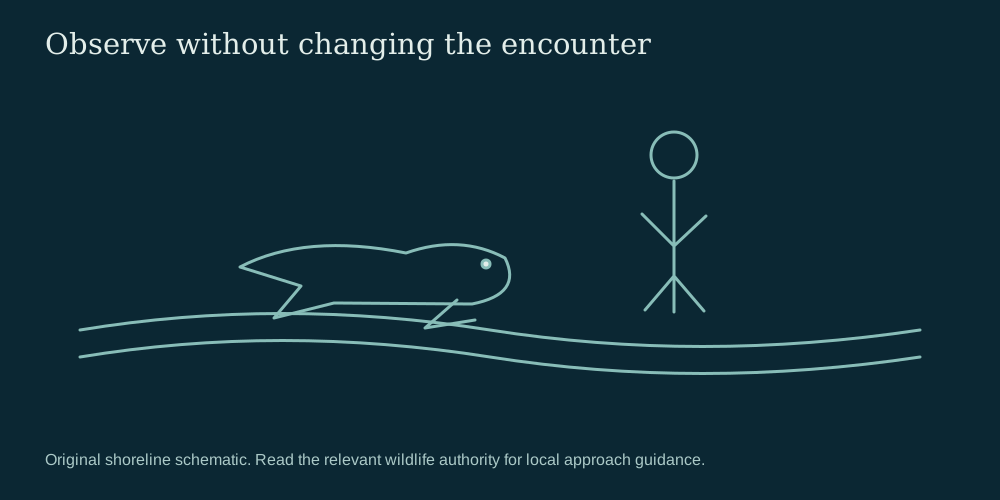
A haul-out is a place where seals leave the water, and it serves more than one purpose: resting, molting, warming, giving birth and nursing all occur there. Seeing seals ashore is therefore not automatically a sign that they are stranded. A resting animal may be conserving energy or using the site for another normal activity. Keep people and pets away so the animals can remain undisturbed. [2]
Pupping time shifts by location, with births generally occurring earlier in the southern West Coast regions than farther north. NOAA’s regional map also notes births outside the typical windows, so a calendar cannot establish that a lone pup has been abandoned or is in trouble. Mothers may leave pups while foraging, and observers should not approach to look for a mother or try to reunite animals. If a seal appears injured or otherwise in need of help, contact the appropriate local stranding network; the West Coast map directs concerned observers to that network. [3]
Separate a general pattern from a local claim
Harbor seals are often described as non-migratory, but tracking has shown that some travel farther than that simple label suggests. The careful conclusion is that travel behavior varies: the tracking finding does not mean every seal undertakes long journeys or follows a single migration route. Likewise, NOAA manages multiple harbor seal stocks whose population trends differ. A stable or increasing stock cannot establish that every colony across the Pacific is doing well. [1]
Consider a hypothetical beach report that says, “A six-foot seal pup appeared here this week.” It combines at least three claims that need separate checks: species, age and measured length. A distant image may support only a tentative species identification; the observation date and location can be compared with regional pupping timing, while allowing for out-of-window births. Species figures of up to about six feet and 285 pounds are upper-end general sizes, not measurements of this individual. Without a reliable scale and suitable view, the report cannot establish its length or age. [1] [3]
The same discipline applies to population language. A regional stock estimate describes a defined management unit, not every animal visible at one haul-out; a handful of seals at a beach is not a census. Use the correct geographic scale, distinguish an observed animal from a population trend, and preserve uncertainty when the available view cannot support a finer identification. [1]
Sources & further reading
Have a correction or a source to suggest? Send a note →