
Reading path: Shoreline wildlife encounters →
Questions to keep separate
| Question or feature | Explanation | What it does not establish |
|---|---|---|
| Distance for a West Coast pup | NOAA pup materials advise 100 yards when possible. [2] | NOAA’s general species guidance uses 50 yards; 100 yards is not a universal statutory rule. [1] |
| Normal haul-out | Pups rest and regulate body temperature ashore; a mother may be feeding nearby. [1] [3] | A lone pup or a fixed number of hours does not prove abandonment. |
| Regional timing | Pupping periods vary, including between inland Washington and the outer coast. [4] | Births can occur outside mapped windows; timing alone is not a diagnosis. |
| West Coast reporting | For visible injury or entanglement, NOAA lists 1-866-767-6114; report location, time and visible condition. [2] [4] | Keep distance and let responders decide whether assessment or intervention is appropriate. |
Shore time can be normal
A harbor seal pup on a beach is not automatically abandoned. Pups haul out to rest and regulate body temperature, and a mother may be feeding nearby. Pups can swim soon after birth, but that ability does not remove their need for undisturbed time ashore. Disturbance from people or dogs can prevent a mother from returning. [1] [2]
A fixed number of hours alone does not establish abandonment. Tides, weather, weaning and disturbance affect how long a pup may remain out of the water. NOAA describes a nursing period of about four to six weeks, after which weaned pups learn to forage independently. That range helps explain why a pup’s age and stage matter, but an observer should not diagnose its condition from time ashore alone. [1] [3]
Give the animal room to rest
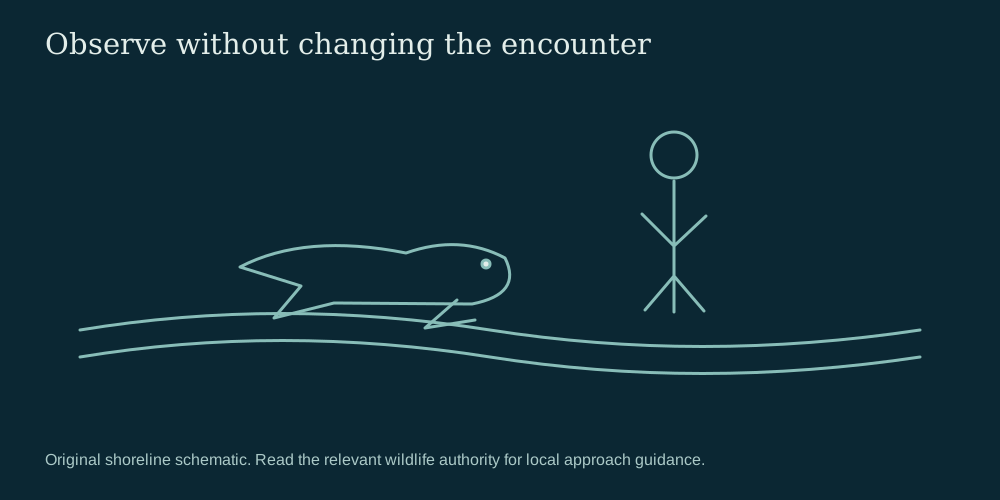
For West Coast harbor seal pups, NOAA’s pup materials recommend staying 100 yards away when possible. NOAA’s general species guidance uses a 50-yard minimum, so the pup-specific recommendation is the larger buffer to use when feasible. The suggested 100 yards is not a universal statutory rule; legal prohibitions concern harassment, and particular rules can vary. Follow any local closure or instruction that applies at the site. [2] [1]
Keep dogs and other people from approaching, and do not feed, relocate or pour water on the pup. Avoid crowding it to take a photograph. These actions can add disturbance and may interfere with a mother’s return. A quiet pup above the tideline with no adult visible may simply be resting while its mother feeds; maintaining distance preserves the possibility of an undisturbed reunion. [2] [3]
Use location and season as context, not diagnosis
Harbor seal pupping periods vary by region. NOAA’s West Coast map distinguishes regional timing, including inland Washington and the outer coast, and notes that births can occur outside the indicated windows. A pup seen outside a regional peak therefore cannot be declared abandoned on timing alone. The map provides context, while the pup’s observable condition and reports to the appropriate network help determine whether assessment is needed. [4] [1]
Seasonal information is not a substitute for an assessment. A headline, posture or close photograph cannot establish that a pup is in critical condition without evaluation by a named responder. Likewise, swimming ability does not prove that it no longer needs shore time. Keep the distinction clear between what you can see—such as an apparent injury or entanglement—and conclusions that require a qualified responder. [1] [4]
Report observations without intervening
If you see visible injury, entanglement or another concern, report it to the regional stranding network rather than attempting care. NOAA’s West Coast pup material lists 1-866-767-6114. Provide the location, time and observable condition from a distance; a responder can decide whether monitoring or intervention is appropriate. Do not move the pup to make it easier to assess. [2] [4]
For example, an observer who sees a pup alone and resting can note its beach location and the time, keep people and dogs back, and call if there is visible injury or entanglement. This report preserves useful facts without turning a lay observation into a diagnosis. Seal Sitters, a permitted local responder network in West Seattle, lists 206-905-7325. Use the appropriate regional contact for where the animal is found. [3] [4]
Sources & further reading
Have a correction or a source to suggest? Send a note →