
Reading path: Dolphins and porpoises →
A closer look at the evidence
| Question or feature | Explanation | What it does not establish |
|---|---|---|
| Identification | Robust body, blunt head, vertical forehead crease and tall curved dorsal fin. [1] | Color and scarring vary with age; a distant or partial view may be inconclusive. [1] |
| Scars | Tooth rakes and marks from prey or other animals contribute to visible patterns. [1] | One mark rarely reveals its cause; scar density is not an exact age measure. [1] |
| Teeth and diet | Usually few lower-front teeth, none in the upper jaw; reported diets are squid-focused. [1] | Fish and crustaceans also occur in reports; diet is not exclusive squid for every animal. [1] |
| Habitat and groups | Temperate and tropical ocean waters, often near slopes and productive shelf edges; groups often number in the tens. [1] [2] | Solitary animals and larger aggregations occur; mixed groups are possible. [1] [2] |
A blunt profile that changes in appearance
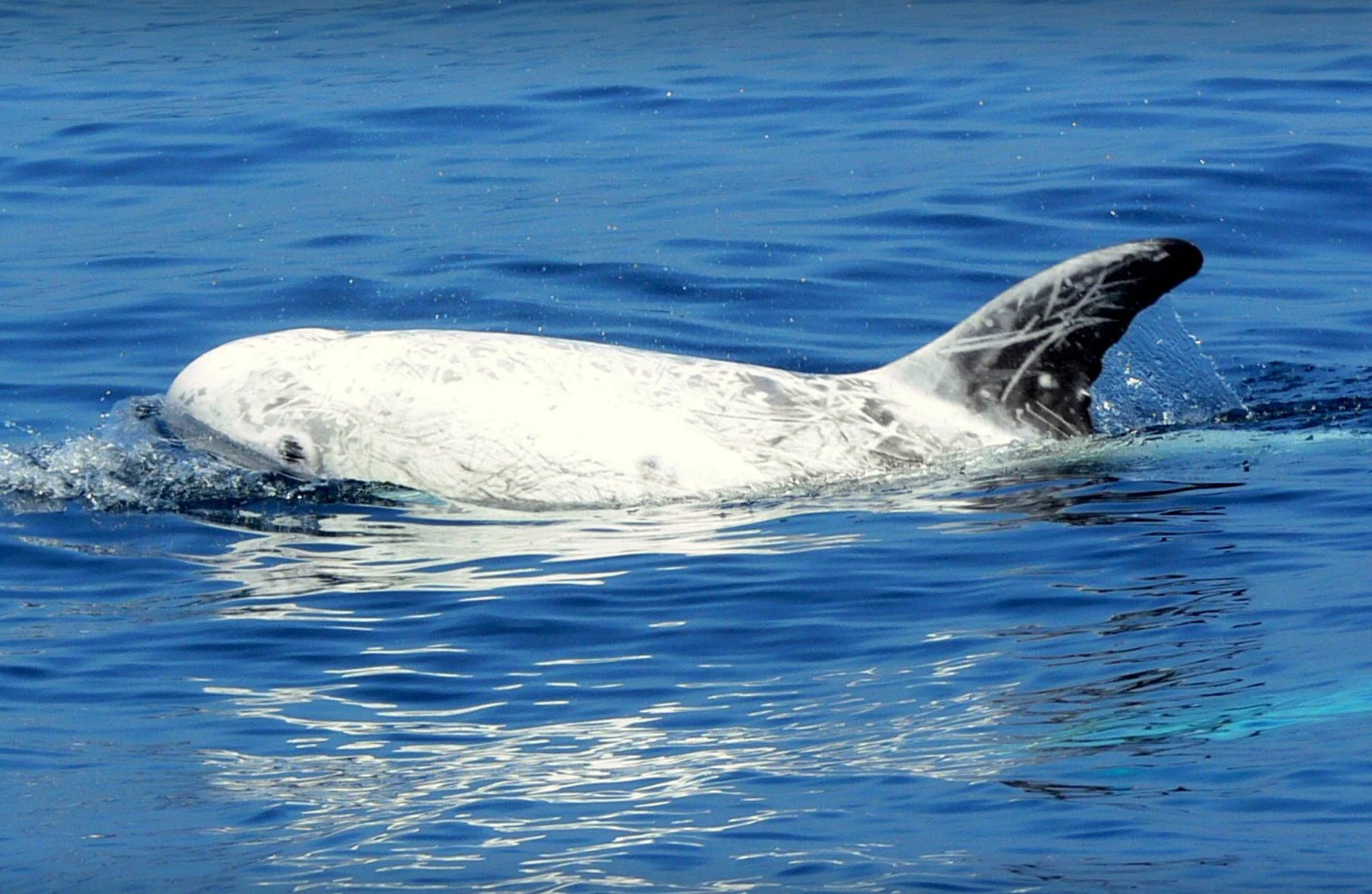
Risso’s dolphin (Grampus griseus) has a robust body and a blunt head without a conspicuous long beak. A vertical crease on the forehead and a tall, curved dorsal fin are useful identification features. These structural clues can remain useful when the animal’s color changes with age. [1]
Calves start dark and have little scarring. Many older adults become pale and heavily marked. A pale animal is not necessarily albino: age-related coloration and accumulated scars can explain a white-looking appearance. But color alone does not provide a precise age, and a distant photograph may not show enough detail to judge the animal’s marks. [1]
Consider a hypothetical comparison between a dark, lightly scarred calf and a pale, heavily scarred adult. Their color and surface markings differ, but the blunt head and curved dorsal fin remain useful shared features. The contrast supports a life-stage interpretation; it does not prove an exact age. [1]
What the scars can—and cannot—tell you
Linear tooth rakes from other dolphins contribute to the scar patterns on many Risso’s dolphins. Prey and other animals can leave additional marks. The accumulated pattern is therefore evidence of a history of interactions, but a single visible mark usually cannot be assigned a cause from a distant view. [1]
Scars are not an exact age clock. Older animals are often more heavily marked, but the degree of scarring varies and the source of an individual mark may be uncertain. Reading a scar as a precise birthdate, or diagnosing a specific encounter from one photograph, goes beyond what the visible evidence can establish. [1]
Few teeth, squid-focused feeding
Risso’s dolphins usually have only a few teeth near the front of the lower jaw and none in the upper jaw. Squid dominate their reported diet, alongside other cephalopods and occasional fish or crustaceans. That combination differs from the image many readers may have of a dolphin with rows of prominent teeth in both jaws. [1]
Much feeding occurs at night, when prey move closer to the surface. For an evidence-reading exercise, separate the population-level diet description from a claim about one animal: “squid dominate reported diets” is supported, while “this dolphin ate only squid” is not. The evidence allows a squid-focused description, not an exclusive diet for every individual or locality. [1]
Reports of long or deep dives should be read as observations or estimates in context, not as the typical duration or depth of every feeding event. An exceptional dive and a representative feeding dive answer different questions. Without a suitable series of observations, the exceptional record alone cannot establish a standard dive profile for the species. [1]
Ocean habitat and group context
Risso’s dolphins occupy temperate and tropical ocean habitat and are often found near continental slopes and productive shelf edges. Groups commonly contain tens of dolphins, though solitary animals and much larger aggregations also occur. They may join mixed groups with other dolphins or whales. [1] [2]
These tendencies describe a broad ecological picture, not a guaranteed encounter size or a fixed habitat boundary. A mixed group does not make every animal the same species, and a pale, scarred dolphin still needs its head shape, fin and other visible traits considered in identification. [1] [2]
NOAA estimates abundance by stock and considers fishing-gear interactions among conservation concerns. Stock-specific estimates and concerns should not be collapsed into a single global status claim; the evidence supplied here does not support calling every Risso’s dolphin population endangered. [1]
Sources & further reading
Have a correction or a source to suggest? Send a note →