
Reading path: Dolphins and porpoises →
A closer look at the evidence
| Question or feature | Explanation | What it does not establish |
|---|---|---|
| Identification | Robust body, short rostrum, conspicuous dorsal fin and pale flank stripes form a useful combined pattern. [1] | Partial flank views can be confused with common dolphins or Dall’s porpoises; a fin-only image is weak evidence. [1] |
| Range | Occurs on both sides of the temperate North Pacific, including off Japan and western North America. [1] [2] | Range-wide distribution does not establish one uniform population or a current trend. [2] |
| Food and feeding | Small schooling fishes and squid are prey; dolphins may cooperate to concentrate fish schools, and conical teeth grip prey. [1] | A feeding observation does not establish the full diet or a universal hunting tactic. [2] |
| Group observations | Groups can number tens or hundreds, with occasional much larger gatherings; leaping and bow-riding are reported. [1] | A group count or jump photograph does not measure total population or typical behavior. [1] |
Read the whole silhouette
The Pacific white-sided dolphin, Lagenorhynchus obliquidens, is a temperate North Pacific species. Its dark back and tail contrast with a pale belly, while complex gray-and-white flank markings break up the side of the body. Pale stripes running along the flanks are sometimes likened to suspenders. The body is robust, the rostrum short, and the dorsal fin relatively conspicuous. Together, these traits make a more useful identification than any single patch of color. [1]
A practical viewing sequence is to note body shape, head profile, fin, flank pattern and location. A full side view can reveal the short rostrum, robust body and pale side stripes together. A dorsal-fin-only image loses both head and flank evidence, making identification less secure even when several dolphins are visible. [1]
Even a good side view has limits. Partial views of the flank pattern can be confused with common dolphins or Dall’s porpoises. Color can also be hard to read in changing light or when animals surface briefly. Use the combination of head, fin, body and geographic setting; do not treat a resemblance or a single photograph as conclusive. [1]
A North Pacific range, not one local population
The species occurs on both sides of the North Pacific, including waters off Japan and western North America. This broad distribution describes a range, not a single uniform community that moves or feeds the same way everywhere. [1] [2]
Groups may contain tens or hundreds of animals, and reports include occasional much larger gatherings. Such numbers describe observed groups, not the total population. A count from one school cannot establish how many dolphins live across the North Pacific, and a large gathering does not by itself show a long-term increase. [1]
Older agency accounts differ in how they partition stocks. A stock count is meaningful only with its assessment year and the definition of the stock being counted; copying a number without those details can create a false impression of a current, range-wide estimate. Likewise, local occurrence or historical fishery mortality should not be presented as a current North Pacific-wide trend. [1] [2]
How prey shape the feeding picture
Small schooling fish—including herring, sardines, anchovies and hake—and squid contribute to the diet. Dolphins may cooperate to concentrate fish schools before catching prey. This offers a mechanism for coordinated feeding: individuals can help make a moving prey school easier to target. It does not mean every group uses the same tactic at every feeding opportunity. [1] [2]
Their conical teeth grip prey rather than grinding it as mammalian chewing teeth do. That distinction helps explain how a dolphin can seize slippery fish or squid, but tooth shape alone does not identify what an individual has eaten. Diet records and observations are needed to establish prey use; a visible feeding event may show behavior without revealing the full menu. [1]
A useful evidence-reading exercise is to separate three claims: the species eats schooling fish and squid; a particular group was seen feeding cooperatively; and the whole population depends on one prey species. The first is supported by the reported diet, the second may be supported by an observation, and the third cannot be inferred from those facts alone. [1] [2]
Movement at the surface and below it
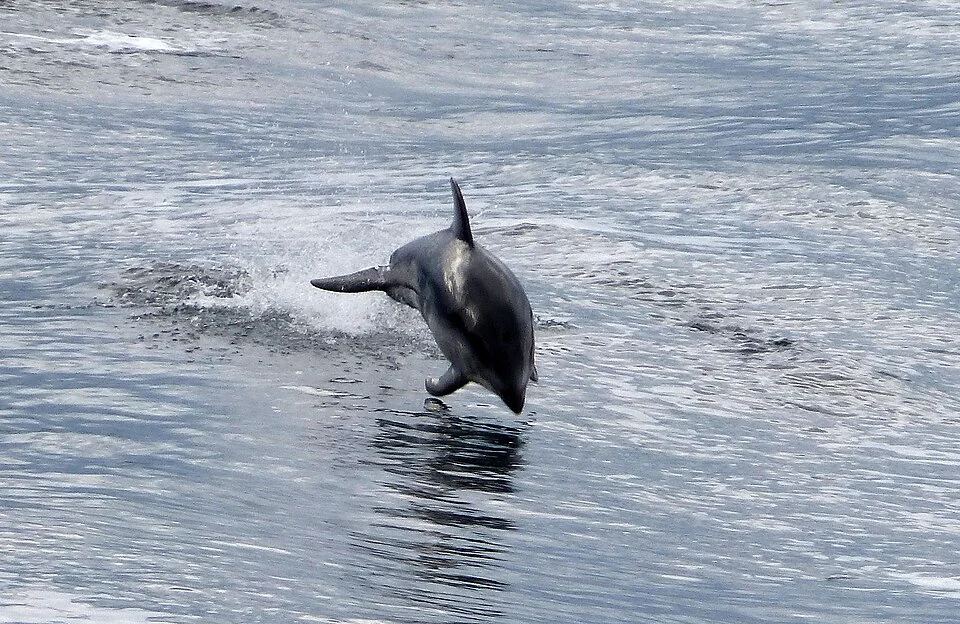
Leaping and bow-riding are reported behaviors, and Pacific white-sided dolphins can associate with other small cetaceans. These observations make encounters visually distinctive, but they do not establish that leaping or riding a vessel is typical at every location or season. A jump photograph captures a moment rather than a behavioral average. [1] [2]
For the same reason, a surface count is a snapshot. Animals may be spread out, submerged or outside the observer’s view, while a school may gather temporarily. Group size, visible activity and range-wide abundance are different measurements and should not be substituted for one another. [1]
Fishing gear is a documented concern
NOAA identifies entanglement in gillnets and other fishing gear as a principal threat considered for the species. Nets can overlap with the dolphins’ use of waters where prey are caught, creating a risk of entanglement. The evidence supports naming this as a conservation concern; it does not justify a claim about a current trend across the entire North Pacific without appropriately dated, comparable assessments. [1]
A careful account of a sighting therefore keeps its scale clear: identify the animal from several visible traits, describe the observed group and behavior, and distinguish those observations from claims about population size or regional trends. The species’ markings and range make it recognizable when the view is complete, but no single encounter can answer every question about its ecology. [1] [2]
Sources & further reading
Have a correction or a source to suggest? Send a note →