
Reading path: Dolphins and porpoises →
A closer look at the evidence
| Question or feature | Explanation | What it does not establish |
|---|---|---|
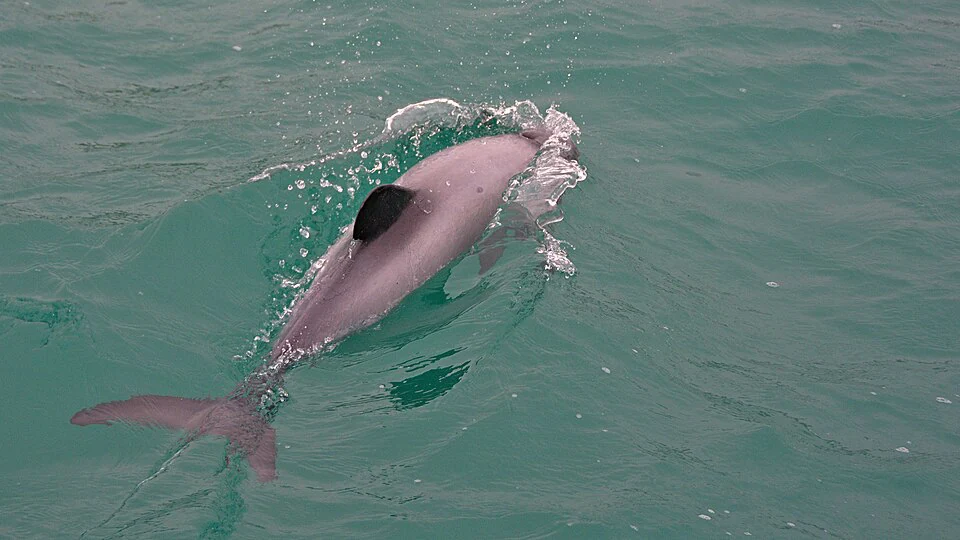
| Rounded dorsal fin | A rounded dark fin, short snout and gray body with black and white markings help recognize the Hector’s/Māui type. [1] | Appearance does not reliably distinguish the two subspecies. [2] |
| Geographic context | South Island Hector’s dolphins occur mainly around the South Island; Māui dolphins occur chiefly off the northwest North Island. [1] [3] | Some South Island Hector’s dolphins have been recorded around the North Island; typical small home ranges do not exclude longer movements. [1] [3] |
| Diet | Small fishes, squid and crustaceans are documented foods. [3] | A coastal sighting alone cannot identify the prey eaten in a particular event. [3] |
| Sightings and confirmation | DOC requests location, date and photographs; DNA can help distinguish subspecies and identify individuals. [2] | A photograph and location support assessment but do not constitute genetic confirmation. [2] |
A rounded fin and compact outline
Hector’s dolphins are endemic to New Zealand and among the smallest oceanic dolphins. A rounded, dark dorsal fin is their most distinctive visible feature: it contrasts with the pointed or sickle-shaped fins familiar from many other dolphins. The body is gray with black and white markings, and the snout is short. Taken together, the fin, color pattern and compact profile make a useful field description. [1]
The fin identifies the Hector’s/Māui type, but it does not reliably identify which subspecies an observer has seen. That distinction matters because the two forms have different principal regions. A photograph of a rounded fin, even a clear one, does not by itself settle the subspecies. [1] [2]
Consider a hypothetical report of a rounded-fin dolphin near the North Island. The feature supports a Hector’s/Māui-type identification, and the location helps frame the possibilities; neither fact alone proves it is a Māui dolphin. A report should preserve the observation as a sighting and avoid turning a likely regional association into a confirmed identity. [1] [2]
Geography narrows the question
South Island Hector’s dolphins occur mainly around the South Island, although some individuals have been recorded around the North Island. The closely related Māui subspecies occurs chiefly off the northwest coast of the North Island. These are geographic patterns, not hard borders that make every animal outside a main area impossible. [1] [3]
Hector’s dolphins tend to show high site fidelity and small home ranges, while longer movements have also been documented. Those observations can coexist: many animals remain in a familiar area, yet movements are not absolutely confined to a tiny patch of coast. NOAA describes typical sightings in coastal waters and notes that some longer movements are possible. [3]
Genetic and morphological evidence supports recognition of the two subspecies. Those evidence types differ from a field photograph: visible traits and location help an observer describe an animal, while genetic analysis can provide a separate basis for distinguishing the subspecies. Even a location that strongly suggests one form remains an inference unless the identification method supports it. [3] [2]
A coastal predator, not a grazer
The diet includes small fishes, squid and crustaceans. Hector’s dolphins are predators; they do not graze on seagrass. Their coastal habitat does not change that basic feeding picture. [3]
A simple hypothetical food observation illustrates the limit of what can be inferred. If a dolphin is seen feeding near a coast, that setting alone cannot tell an observer whether it caught a fish, squid or crustacean. The documented diet establishes possible prey categories, while a specific meal requires evidence tied to the actual feeding event. [3]
Slow replacement and conservation pressures
Slow reproduction limits how quickly populations can replace adults lost to bycatch. Gillnet and trawl bycatch, disease and other pressures contribute to conservation concern. The mechanism is important: when losses occur, slow reproduction constrains the pace at which the affected population can add animals. These facts support concern without implying that every local group has the same status or that one pressure explains all changes. [3] [1]
New Zealand conservation categories and United States Endangered Species Act listings belong to different legal systems. A category from one jurisdiction should not be described as though it were the other jurisdiction’s classification. Similarly, any population estimate should retain its survey year and age coverage; a rounded homepage figure is not necessarily a complete census including calves. [1] [3]
Make a sighting useful
New Zealand’s Department of Conservation requests sightings with location, date and photographs. Record where and when the animal was seen, and preserve images that show the fin, body markings and surrounding context. This information supports review, but a sighting report is not itself a genetic confirmation. DNA can help distinguish Māui from Hector’s dolphins and can also help identify individuals. [2]
For a hypothetical report, a clear photograph of a rounded fin plus a precise location and observation date gives reviewers more context than a fin image without those details. If the animal is near the North Island, the location informs the question but does not settle the subspecies. Do not approach an animal to obtain a closer image; the useful procedure is to report the observation through the official channel and leave identification to the available evidence. [2] [1]
The most defensible field conclusion is often specific but bounded: a small, gray dolphin with black-and-white markings and a rounded fin is consistent with the Hector’s/Māui type in New Zealand. Location can refine that assessment, and genetic evidence may resolve what appearance cannot. [1] [2]
Sources & further reading
Have a correction or a source to suggest? Send a note →