
Reading path: Beach finds and shell forms →
A starting key to visible shell structures
| Question or feature | Explanation | What it does not establish |
|---|---|---|
| Hinge and valves | Two hinged valves indicate a bivalve; a beach find may be one separated valve. [1] | A single valve hides the complete paired form and may have a damaged hinge. [1] |
| Apex opening | In the Central/South Florida key, a hole in a low conical shell leads to the keyhole-limpet branch. [3] | The key is regional, and wear can obscure the apex. [3] |
| Aperture and canal | Opening shape and siphonal-canal presence or length help narrow coiled-shell paths. [3] | These characters narrow a regional key; they do not guarantee a species identification. [3] |
| Collection status | Confirm that a shell is unoccupied and check local collection rules. [4] | Cumberland Island rules are park-specific, not universal beach regulations. [4] |
Start with the kind of shell
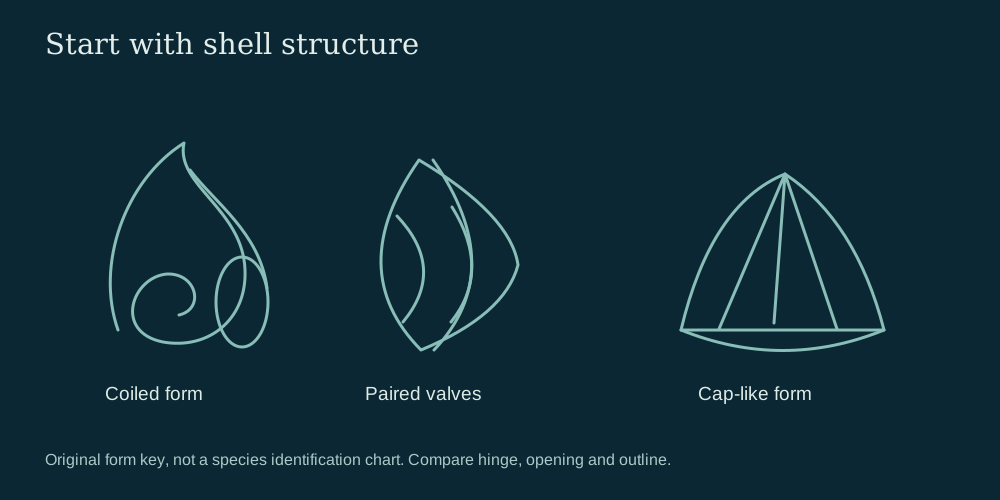
A color match is a weak first step: colors fade, stain, and vary. Begin by asking what body plan the shell represents. A bivalve has two valves joined at a hinge, though a beach find may be only one separated valve. Gastropods include snails, limpets, and abalone; not every gastropod presents an obvious spiral. Chitons have eight overlapping plates rather than a pair of hinged valves. [1] [2]
A simple group-level chart can therefore begin: paired hinged valves → bivalve; eight overlapping plates → chiton; one-piece cap or coiled shell → investigate gastropod branches. Mollusk shells are made of calcium carbonate, but material alone does not identify a group or species. [2]
Follow shape and openings
For a low-conical gastropod shell, inspect the top. In the Central and South Florida key, an apical hole leads to the keyhole-limpet branch; a low cap without that opening leads toward true limpets. The chart’s distinction depends on seeing the apex clearly, which erosion or breakage can obscure. [3]
For a shell with a coiled outline, look for a spire, then examine the aperture—the opening—and any siphonal canal extending from it. The regional key uses canal presence and length, along with aperture shape, to narrow possible groups. A slitlike underside versus an open underside with a shelf helps distinguish cowrie-like from slipper-snail paths in that key. These are routes through a regional guide, not universal rules that guarantee a species name. [3]
Use ornament as supporting evidence
Ribs, beads, spines, and knobs can help separate shells that have similar outlines. The North Carolina guide also uses sculpture, shape, hinge, and aperture characters. Compare multiple structural features rather than deciding from a single ridge or color patch. [1]
A worked route: suppose a find is a low cap with a clearly visible hole at the apex. The chart sends it to the keyhole-limpet branch, not straight to a species label. If the hole is absent, check whether the shell is intact before following the true-limpet branch. If the apex is worn away, record the identification as unresolved at that split rather than treating damage as evidence that no hole existed. [3]
Make the chart honest about uncertainty
The Central and South Florida gastropod key is regional, so a shell from another coast should not be assigned a Florida species just because its shape follows one branch. The North Carolina guide is an older institutional reference; names and distribution statements may need modern confirmation. Wear can erase diagnostic structures, making a family or broad-group identification more defensible than a species claim. [3] [1]
For a worn single valve, photograph both the outer surface and the hinge or interior with a scale, and record the coast and collection date. A single valve cannot show the complete paired shell, and a missing hinge or chipped aperture may remove the very character a key needs. Treat the result as a candidate identification, not a certainty. [1]
An apparently empty shell may still contain an animal. Check local rules before collecting: the National Park Service’s Cumberland Island guidance, for example, distinguishes unoccupied shells from occupied shells and applies to that park. It is not a general rule for other beaches. [4]
Sources & further reading
Have a correction or a source to suggest? Send a note →