
Reading path: Underwater images and evidence →
Depth zones are working boundaries
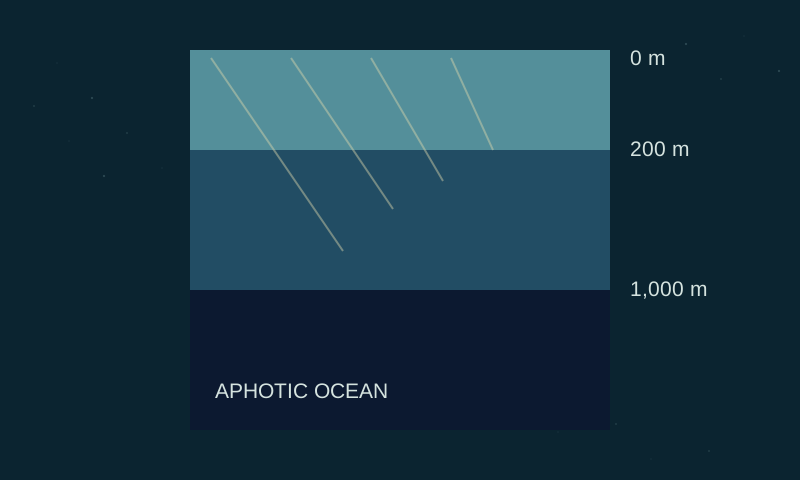
Oceanographers often describe the upper roughly 200 meters as the sunlit or euphotic zone, the interval from about 200 to 1,000 meters as twilight, and deeper water as aphotic. These labels summarize how sunlight generally fades; they do not mark walls in the water. The twilight zone can contain a trace of detectable light even where there is too little for photosynthesis, while conditions near either boundary vary with water clarity and local setting [1].
Imagine two sensors lowered on the same day, one beneath clear offshore water and one beneath a turbid coastal plume. Both record declining light with depth, but the coastal sensor may show the useful daylight range ending sooner. That hypothetical comparison illustrates why a depth chart is a guide to expected conditions, not a substitute for measuring light at a particular place.
Water filters sunlight by wavelength
Water does not dim every color equally. Red wavelengths are absorbed relatively quickly, while some blue light can travel farther through clear seawater. Suspended particles, dissolved material, and plankton also scatter or absorb light, changing how much reaches a given depth. As a result, the amount of light available to photosynthetic organisms depends on both depth and the optical character of the water.
A hypothetical diverging beam of white light would lose its warmer colors first as it passes downward; deeper illumination would be weaker and bluer. The biological consequence is not simply that the ocean becomes visually dark. Photosynthesis requires enough usable light to power carbon fixation, and that threshold can be crossed well before every instrument stops detecting photons. The approximate 200-meter boundary captures this distinction between detectable light and light sufficient for photosynthesis [1].
Darkness is about sunlight, not all light
Below the aphotic boundary, sunlight does not meaningfully illuminate the habitat. Yet some animals produce bioluminescence through chemical reactions in their own tissues or associated organisms. That glow is not sunlight traveling down from the surface, and it does not make deep water photosynthetic. It can instead serve roles such as signaling or confusing a predator.
For example, researchers have documented the deep-water nudibranch Bathydevius caudactylus glowing and apparently detaching a luminous tail projection during an encounter. That observation shows how animal-made light can function in a habitat without sunlight; it does not imply that the surrounding water has become daylight-like [2]. A brief flash may be conspicuous nearby while leaving the broader environment dark.
Depth also changes pressure and habitat
Light is only one dimension of depth. Pressure rises by roughly one atmosphere for each additional 10 meters of seawater, so an animal at 1,000 meters experiences about 100 atmospheres more pressure than at the surface. Temperature, food supply, currents, and distance from the seafloor also shape habitat. These variables change together in many settings, but they are not interchangeable measures.
The abyssal plain is commonly associated with depths around 4,000 to 6,000 meters, yet the seafloor is not uniformly that deep. A deep ocean animal can occupy the water column far above the bottom, and trenches extend much deeper than ordinary abyssal plains. Thus, calling a place “deep” requires context: sunlight may already be absent at a depth where the bottom is still far below, and pressure continues increasing with every additional meter. The zone names organize observations; they do not replace the physical measurements that explain life in a particular location.
Sources & further reading
Have a correction or a source to suggest? Send a note →